INDEPENDENT SOURCE INTERVENTIONS / OCTOBER 16, 2026
MP3 to MIDI.
Two changes. Separately.
At fixed pitch and touching construction slots, the continuous/global anchor exported 2 / 2 MIDI events in WAV / MP3. Resetting phase alone produced 4 / 4; per-slot envelopes alone 4 / 5; both together 4 / 4. The mixed cells are new offline CPU inference. Anchors are exact-input reuse. Counts neither identify musical intent nor establish a safe setting.
The mixed cells
were the missing controls.
| Cell | Phase | Envelope | WAV | MP3 | Inference provenance |
|---|---|---|---|---|---|
| A | continuous | global | 2 | 2 | Retained Oct15 anchor |
| B | reset | global | 4 | 4 | New Oct16 CPU inference |
| C | continuous | per-slot | 4 | 5 | New Oct16 CPU inference |
| D | reset | per-slot | 4 | 4 | Retained Oct15 anchor |
A / Continuous phase / global envelope
WAV / MP3 events: 2 / 2. Retained Oct15 anchor. WAV source RMS: 0.213728.
B / Reset phase / global envelope
WAV / MP3 events: 4 / 4. New Oct16 CPU inference. WAV source RMS: 0.213740.
C / Continuous phase / per-slot envelope
WAV / MP3 events: 4 / 5. New Oct16 CPU inference. WAV source RMS: 0.212529.
D / Reset phase / per-slot envelope
WAV / MP3 events: 4 / 4. Retained Oct15 anchor. WAV source RMS: 0.212529.
The preceding held-and-repeated audio test changed phase restarts and per-slot envelopes together. Cells B and C separate those generator settings. B restarts the sine phase at the fixed boundaries without adding internal fades. C keeps the sine phase continuous but adds the per-slot edges. Neither changes the sample-clock slots, selected pitch, nominal amplitude or extraction settings.
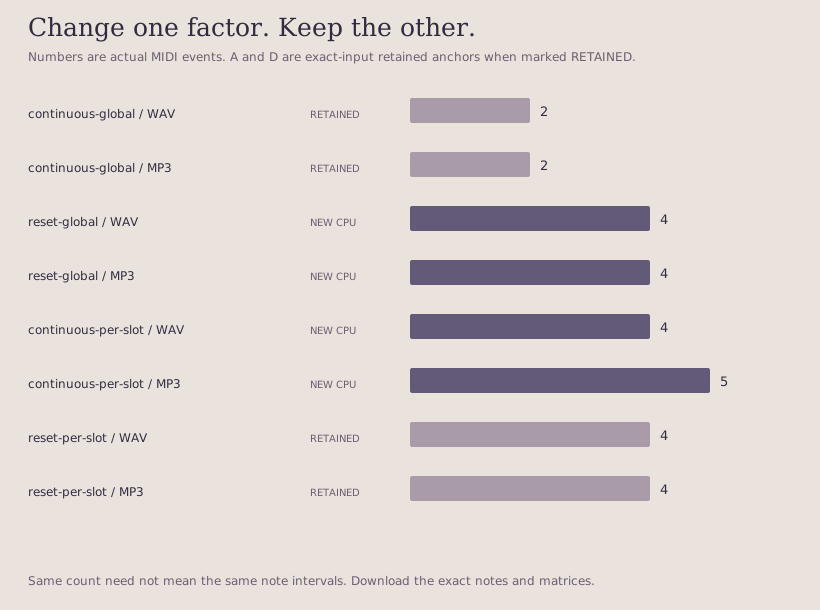
Keeping the global envelope, the phase intervention changes the count from 2 / 2 to 4 / 4 in WAV / MP3. Keeping continuous phase, the envelope intervention changes it from 2 / 2 to 4 / 5. The combined cell ends at 4 / 4. Those are conditional observations in these authored inputs, not two independent promises that can be added together.
Arithmetic is not
a universal effect.
| Conditional contrast | Formula | WAV | MP3 |
|---|---|---|---|
| Phase with global envelope | B - A | 2 | 2 |
| Phase with per-slot envelope | D - C | 0 | -1 |
| Envelope with continuous phase | C - A | 2 | 3 |
| Envelope with reset phase | D - B | 0 | 0 |
| Cross-difference | (D - C) - (B - A) | -2 | -3 |
Phase with global envelope
Formula: B - A. WAV / MP3 event-count difference: 2 / 2.
Phase with per-slot envelope
Formula: D - C. WAV / MP3 event-count difference: 0 / -1.
Envelope with continuous phase
Formula: C - A. WAV / MP3 event-count difference: 2 / 3.
Envelope with reset phase
Formula: D - B. WAV / MP3 event-count difference: 0 / 0.
Cross-difference
Formula: (D - C) - (B - A). WAV / MP3 event-count difference: -2 / -3.
For the global envelope, phase contributes B - A events. For the per-slot envelope, the same phase comparison is D - C. Holding continuous phase gives the envelope comparison C - A; holding reset phase gives D - B. Every input count comes from its named, saved MIDI file, not an estimated curve. The result JSON records the formula, input filename and count for each calculation.
The cross-difference is (D - C) - (B - A): -2 in WAV and -3 in MP3. It describes how the event-count contrast differs between these two envelope conditions. It is not a probability, a significance test, statistical independence or an effect size that can be transferred to another sound. WAV and MP3 are paired encodings of authored controls, not independent statistical replicates.
Both reset-phase cells have the same total count within each format here, but the total is only one field. The comparisons below separately check the complete parsed note fields and the actual MIDI byte hash. A matching total does not by itself establish matching boundaries, velocity or any musical interpretation.
- B versus D / WAVCounts: 4 and 4. Complete parsed pitch/tick/duration/time/velocity fields identical: no. MIDI SHA-256 identical: no.
- B versus D / MP3Counts: 4 and 4. Complete parsed pitch/tick/duration/time/velocity fields identical: no. MIDI SHA-256 identical: no.
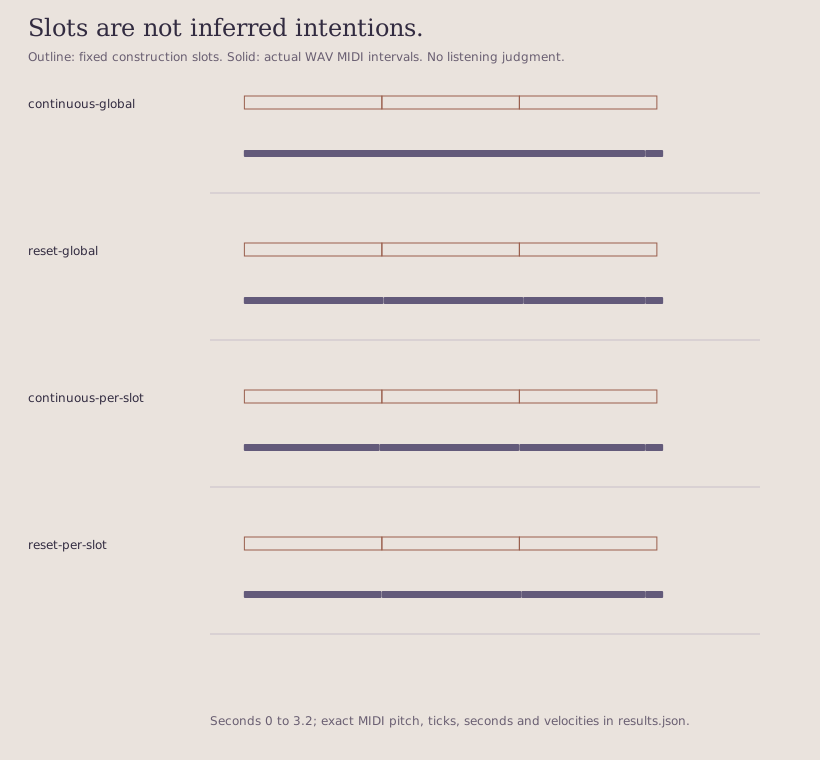
All exported events in this measured matrix are at MIDI pitch 60; the results retain a separate other-pitch count rather than concealing it in the total. The exact start, duration and velocity fields remain available even where a count does not change. No live conversion program or old export was edited to produce these comparisons.
A slot is a construction boundary.
Not an inferred attack.
The three fixed construction slots occupy 0.2 to 1.0, 1.0 to 1.8, 1.8 to 2.6 seconds. There is no positive silent gap between slots. Every file has 70560 samples at 22050 Hz, lasting 3.2 seconds. A slot has 17640 samples. These are selected generator parameters, not thresholds discovered from music.
For continuous phase, the sine argument uses i - firstSample through every slot. Reset phase instead uses i - slotStart. The global envelope uses distances from the first slot's start and final slot's end. The per-slot envelope uses distances from each slot's own edges. Both use min(1, distanceFromStart / fadeSamples, distanceToEnd / fadeSamples), with the last included sample one before the end. The fade length is 220 samples and the amplitude multiplier is 0.35 before 16-bit quantization.
The continuous/global waveform is the preceding test's single-held control, even though today's implementation visits three bookkeeping slots. Calling those slots three musical notes would relabel the same audio without evidence. We do not do that. The reset/per-slot waveform reproduces the preceding touching, separately enveloped construction. Both anchor identities are established by actual input and decoded-sample hashes, not by their display names.
The mixed interventions are synthetic signal changes. Restarting phase can create an internal waveform discontinuity; adding per-slot envelopes changes amplitude around the boundaries. This does not isolate a performer's intention or prove what a listener would hear. Source RMS values are A 0.213728; B 0.213740; C 0.212529; D 0.212529 for the four WAV sources. We did not normalize them to equal energy, and fixed nominal amplitude is not an equal-RMS claim.
Old anchors stay old.
New inference stays named.
There are 4 fresh input inferences and 4 retained exact-input anchors. For every proposed anchor we regenerate WAV, encode MP3 with native FFmpeg at 128 kbps, decode to mono float32 samples, and compare the actual input and decoded hashes with the retained Oct15 control. We reuse a capture only after those comparisons and the model-hash check succeed. Retained capture timestamps are preserved, not replaced by today's date.
Cells B and C actually run the installed original model on the offline CPU backend. Basic Pitch 1.0.1, TensorFlow.js 3.21.0, MIDI writer 2.0.28 and v24.19.0 on win32 are recorded. Detection thresholds stay at 0.25 and 0.25, with a 5-frame extraction minimum. We retain each frame, onset and contour matrix; a separate replay checks the exact MIDI export hash.
Model manifest SHA-256: 1ed1aaee3409ec1dc098c8b01f430c0911f6fe9412e7af8086750f9e8f302f68. Combined weight SHA-256: b142a95737a52e1e412d5f92e73d8bb80dfe8d04941acc0702f11f4524fb377c. Converter source SHA-256: e42f9b0b60bb6fd73b2539a1ae9ca3b09f34ab874e35423162b384df68c19660. These checks keep a source intervention separate from a change in the transcription model or the public tool. An identical retained waveform is an anchor, not a second newly discovered result.
MP3MIDITool's repair guidance conditions fragment merging on belonging to a held note. That observed distinction prompted these original controls. This is not a test of its converter, a natural instrument, a vocal performance, browser inference, a DAW or a physical phone. No musical-accuracy percentage, safe setting or automatic-intent rule follows from this matrix. The public converter and all previous experiment bodies remain unchanged.
Keep the interval fields.
Each line below comes from the actual re-parsed Standard MIDI. Seconds are rounded to six decimal places for reading; the result JSON also retains full numeric fields, ticks, duration ticks, PPQ and velocity. Counts with the same value still have their own corresponding export and captured model output. Neither a plotted rectangle nor a rounded timestamp is used as a substitute for the MIDI.
- Continuous phase / global envelope / WAVpitch 60 / start 0.196875 s / duration 2.334375 s; pitch 60 / start 2.532292 s / duration 0.104167 s
- Continuous phase / global envelope / MP3pitch 60 / start 0.196875 s / duration 2.334375 s; pitch 60 / start 2.532292 s / duration 0.104167 s
- Reset phase / global envelope / WAVpitch 60 / start 0.196875 s / duration 0.812500 s; pitch 60 / start 1.010417 s / duration 0.812500 s; pitch 60 / start 1.822917 s / duration 0.709375 s; pitch 60 / start 2.532292 s / duration 0.104167 s
- Reset phase / global envelope / MP3pitch 60 / start 0.196875 s / duration 0.801042 s; pitch 60 / start 0.998958 s / duration 0.823958 s; pitch 60 / start 1.822917 s / duration 0.709375 s; pitch 60 / start 2.532292 s / duration 0.104167 s
- Continuous phase / per-slot envelope / WAVpitch 60 / start 0.196875 s / duration 0.789583 s; pitch 60 / start 0.986458 s / duration 0.812500 s; pitch 60 / start 1.800000 s / duration 0.732292 s; pitch 60 / start 2.532292 s / duration 0.104167 s
- Continuous phase / per-slot envelope / MP3pitch 60 / start 0.196875 s / duration 0.789583 s; pitch 60 / start 0.986458 s / duration 0.812500 s; pitch 60 / start 1.800000 s / duration 0.162500 s; pitch 60 / start 1.962500 s / duration 0.569792 s; pitch 60 / start 2.532292 s / duration 0.104167 s
- Reset phase / per-slot envelope / WAVpitch 60 / start 0.196875 s / duration 0.801042 s; pitch 60 / start 0.998958 s / duration 0.812500 s; pitch 60 / start 1.811458 s / duration 0.720833 s; pitch 60 / start 2.532292 s / duration 0.104167 s
- Reset phase / per-slot envelope / MP3pitch 60 / start 0.196875 s / duration 0.801042 s; pitch 60 / start 0.998958 s / duration 0.801042 s; pitch 60 / start 1.800000 s / duration 0.732292 s; pitch 60 / start 2.532292 s / duration 0.104167 s
Inspect the inputs
and the capture dates.
Full results and provenance include every input hash, capture origin, original timestamp, parsed note and arithmetic input. Reproduction code runs in this project's locked environment as node scripts/measure-phase-envelope.cjs. The preceding Oct15 evidence is required to verify retained anchor provenance. With retained captures, --replay refuses missing inference instead of inventing a result.
- Continuous phase / global envelope / WAV inputRETAINED OCT15 ANCHOR. Original capture time: 2026-10-14T19:05:22.338Z. Input SHA-256:
8780cec3dd86f263829c64ef4360cc70c8133db21b1ee09298efc7516bde82de. Model output SHA-256:7402d7905c52780f7838efd1814986016e497721480aa53dc517a3bf5f1435ac. Actual MIDI SHA-256:517ba4fc4edf6258dc8a2359f9a37017df78046f66419911de134899baea2edb. - Continuous phase / global envelope / MP3 inputRETAINED OCT15 ANCHOR. Original capture time: 2026-10-14T19:05:32.757Z. Input SHA-256:
de975586ddefd73e0c23fef8e8a217deefa212d87a8832a9380e52c232ad59d5. Model output SHA-256:5995abca2f4ff5d64774c40ff8ae5ce1af6a5de575c6e9e059b47d91974c6fb8. Actual MIDI SHA-256:9f320d15b46ba27b7359b640a63fa4db56ca714a73fb0bf6f239b3b5813fb3bb. - Reset phase / global envelope / WAV inputNEW OCT16 CPU INFERENCE. Original capture time: 2026-10-15T19:05:10.867Z. Input SHA-256:
ea7b0345d322b26abe3b173f8d2352a201bc352fcaa5f25d8cad5a99eb3544da. Model output SHA-256:5d59269775fe2520664cb47b5bf4efff8d061adc5aae857e205d4236b35a6739. Actual MIDI SHA-256:9b57bc7eb70d727434d86728f62efd8e50ec16ff720ae97109bd6368c3f1caf9. - Reset phase / global envelope / MP3 inputNEW OCT16 CPU INFERENCE. Original capture time: 2026-10-15T19:05:22.022Z. Input SHA-256:
626abf34281d873fa30543c6c2c69927d6d7864014813c0ef5160ce52401171a. Model output SHA-256:cc43a4191f9b9ccbe897dfb837147017fa8a8ad22e2ede02fb6a180cc6f4b9b3. Actual MIDI SHA-256:e71d8c9226859e365ae55c4e15d3e622c524774a279f31e09c1d37cc673e3acd. - Continuous phase / per-slot envelope / WAV inputNEW OCT16 CPU INFERENCE. Original capture time: 2026-10-15T19:05:32.410Z. Input SHA-256:
2ce159a211ae758bde628762860a9e808fb98e99a1fce315b545832c4ccbf31f. Model output SHA-256:c532821e1853f8dc7e92ab4e819d67b6cfef669fe63671825b8119fd86940da4. Actual MIDI SHA-256:2c433df7dbef770990118a1e61d78526eabff981a9ac944d724d71c33b6e5c2c. - Continuous phase / per-slot envelope / MP3 inputNEW OCT16 CPU INFERENCE. Original capture time: 2026-10-15T19:05:42.832Z. Input SHA-256:
91e301dc9563b7b46d3700161a0460c01de69c10b2c539de9fd4fdba7ffecfb6. Model output SHA-256:87a919746c8e15384b28be732bed622007665aacb880ad9c611ce977a478f04b. Actual MIDI SHA-256:f33541f26f75be4b5fc4e2c5d7533401ec92e562f5adc6e50b8bb61dc26cbbef. - Reset phase / per-slot envelope / WAV inputRETAINED OCT15 ANCHOR. Original capture time: 2026-10-14T19:05:43.004Z. Input SHA-256:
56a7d4dc215780e1f885041e9787b1972a710eafd1b24419c9645e39d955a13c. Model output SHA-256:aac1d1667a6f7d221a9f1ebfa045b1c05411acb118f273c7ace560124d4082da. Actual MIDI SHA-256:b6696518c69192d79572a366ceb54bef9bd66c819faa7ac0c332ae67f0ac48c6. - Reset phase / per-slot envelope / MP3 inputRETAINED OCT15 ANCHOR. Original capture time: 2026-10-14T19:05:56.225Z. Input SHA-256:
8a69d6b23a6ff7693686b2f8f0f23f38dbebfeea115a2fac2a20d7fe24b302e8. Model output SHA-256:8c9955b3c9a2d50767c3a1c51c70650a3514b331f78977034cfad4be4bca5b5c. Actual MIDI SHA-256:68cd20497cc7710fc988e4e914d6b82cce93cb5f68d0bc5a3a52fd92579221c9.
All audio is project-authored. No visitor recording is uploaded or used in this experiment. Downloading these synthetic controls does not change the public tool's local-media workflow. The joining rule experiment and MIDI-only counterexample retain their original claims and reciprocal links.