FIXED-OUTPUT EXPERIMENT / OCTOBER 9, 2026
MP3 to MIDI.
Selective is not safer.
A higher detection threshold can remove notes you wanted to keep. At 0.55, our four fixed-output controls each exported four reference-pitch events. At 0.70, the fundamental WAV kept two and its MP3 kept one, while both stronger-partial controls kept four. At 0.85, every control produced no notes. These are offline re-extractions, not recommended browser settings.
Fewer events.
Not necessarily the right events.
| Generated input | 0.10 | 0.25 | 0.40 | 0.55 | 0.70 | 0.85 |
|---|---|---|---|---|---|---|
| Fundamental WAV | 445 | 9 | 4 | 4 | 2 | 0 |
| Fundamental MP3 | 464 | 8 | 4 | 4 | 1 | 0 |
| Stronger-partial WAV | 511 | 13 | 8 | 4 | 4 | 0 |
| Stronger-partial MP3 | 509 | 14 | 7 | 4 | 4 | 0 |
Fundamental WAV
Thresholds: 0.10 / 0.25 / 0.40 / 0.55 / 0.70 / 0.85.
Events: 445 / 9 / 4 / 4 / 2 / 0.
Fundamental MP3
Thresholds: 0.10 / 0.25 / 0.40 / 0.55 / 0.70 / 0.85.
Events: 464 / 8 / 4 / 4 / 1 / 0.
Stronger-partial WAV
Thresholds: 0.10 / 0.25 / 0.40 / 0.55 / 0.70 / 0.85.
Events: 511 / 13 / 8 / 4 / 4 / 0.
Stronger-partial MP3
Thresholds: 0.10 / 0.25 / 0.40 / 0.55 / 0.70 / 0.85.
Events: 509 / 14 / 7 / 4 / 4 / 0.
The low-threshold exports are not just slightly longer versions of the middle-threshold exports. At 0.10 the fundamental WAV contains 445 events and its MP3 contains 464; the stronger-partial pair contains 511 and 509. All four include lower as well as higher pitches relative to their assigned source-slot reference. These counts are exported note events, not unique pitches, successful conversions or an accuracy percentage.
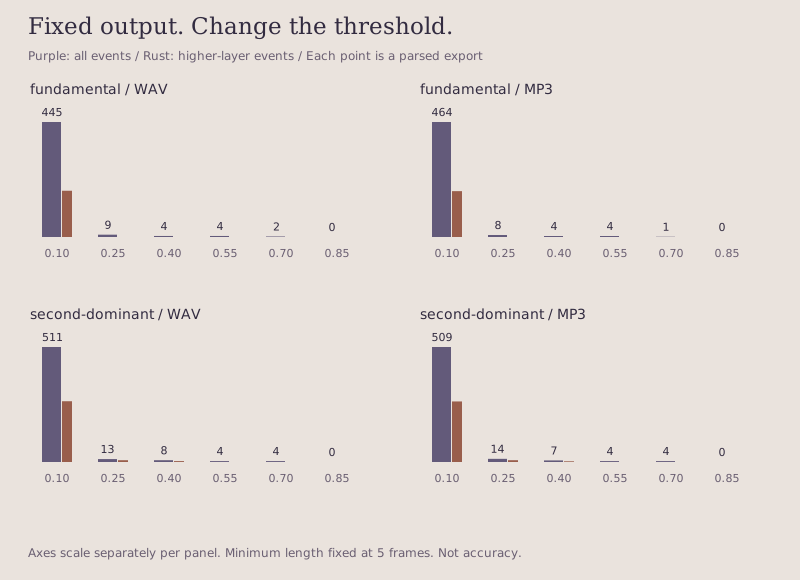
The same threshold does not affect both spectra equally.
At 0.25, the fundamental WAV and MP3 contain nine and eight events with no higher-layer events. Both cover all four reference slots, but their extraction outputs include three and four short fragments. At that same threshold the stronger-partial WAV and MP3 contain thirteen and fourteen events, including eight higher-layer events each. One number therefore describes two materially different exported shapes.
At 0.40, both fundamental controls contain four reference events. The stronger-partial WAV still contains eight events, four higher; the MP3 contains seven, three higher. At 0.55 those upper events disappear and all four controls contain four reference events. This is the observed result for these saved outputs, not proof that this threshold separates harmonics from real polyphonic notes in an arbitrary recording.
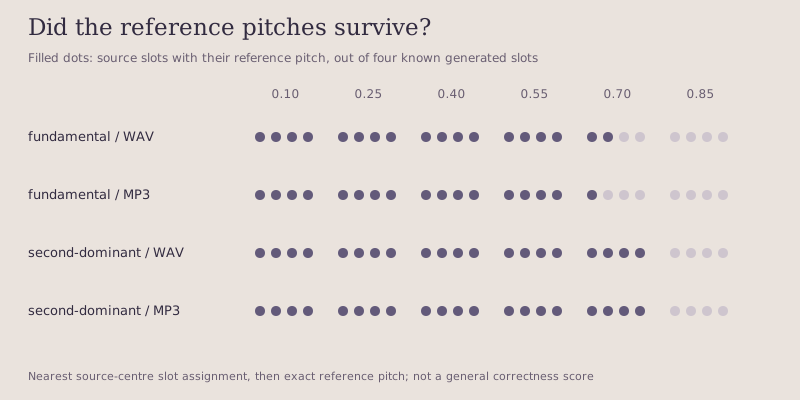
What a quieter piano roll can hide.
Increasing selectivity removed upper layers in this experiment, but increasing it again removed reference pitches from the fundamental controls. At 0.70, stronger partials and fundamentals no longer follow the same pattern. At 0.85 there are no events in any of the four extractions, so we did not manufacture an empty MIDI file and label it a successful transcription.
The threshold affects boundaries as well as the presence of a pitch. At 0.70 the fundamental WAV's two surviving events are both short fragments under our frame-based definition; the MP3's single surviving event is also short. Those are not intact versions of all four source tones. The frame threshold participates in determining the end of an event, and minimum duration remains a separate rejection step.
These are direct checks you can make on the downloadable files: compare event counts, inspect the pitches and ticks, and compare which known source slots still contain a reference event. We parsed each exported MIDI back into note events rather than reporting only the extraction array. An apparently less cluttered result is not enough to decide which version to keep.
Do not copy the numbers into another converter's slider. Our experiment passes the same numeric value directly to the installed extractor's onset and frame parameters. It does not establish how a product maps its displayed sensitivity control, whether that mapping is reversed, or how its frequency bounds and processing backend alter the outcome. Our live homepage has not gained a sensitivity control in this update.
The input did not change.
Neither did the model output.
We reused the four generated inputs and the retained CPU captures published with the minimum-note-length experiment. There is no fresh model inference in this test. For each input, the stored frame, onset and contour arrays are the same arrays for every threshold, with fresh deep copies supplied to each extraction. Input bytes, compressed capture bytes and the decoded JSON content are checked with SHA-256.
The six values are 0.10, 0.25, 0.40, 0.55, 0.70 and 0.85. At each step both onset and frame parameters receive the same value. Minimum note length is fixed at five frames; inferred onsets, residual-energy extraction and energy tolerance retain the installed defaults. Basic Pitch 1.0.1 and the MIDI writer 2.0.28 are the installed versions used here. This is a joint threshold sweep, not an isolated test of either parameter.
The four known source pitches are 48, 52, 55 and 60. Their starts are 0.20, 0.75, 1.30 and 1.85 seconds, with each generated tone lasting 0.35 seconds. We assign each parsed event to the nearest source centre by its midpoint. A reference event has exactly that slot's known pitch; higher and lower events are defined relative to the same reference. This assignment is a disclosed counting rule, not proof of a detector's intent.
slot = argmin(abs((parsedStart + parsedDuration / 2) - (sourceStart + 0.35 / 2)))
Reference-slot coverage counts slots with at least one exact reference-pitch event. Short fragments have extracted duration of at most ten frames, before conversion to seconds. These two counts measure different properties.
We exported twenty nonempty MIDI files and parsed them back. Four zero-note cases have no MIDI file. The 0.25 exports are byte-identical to the prior experiment's five-frame exports, providing a baseline check of the reused captures and export path. Starts are clamped at zero, duration at 0.03 seconds and velocity to 0.05–1, following the existing export path; MIDI time is then quantized to ticks. Those export rules are unchanged across all runs.
To reproduce, place the published inputs and captures beside the result JSON under the evidence directory in this project, install the declared package versions and run node scripts/measure-sensitivity.cjs. The published reproduction script documents the folder layout and every extraction call. It verifies hashes against the preceding length experiment, whose full evidence remains available. No external conversion service receives these files.
The question came from a real control.
Tuneonmusic's settings explanation describes sensitivity as moving onset and frame thresholds together. Its extra-note guidance connects unwanted detections with harmonics and suggests changing sensitivity. That prompted this joint-threshold test, not a test of Tuneonmusic itself.
We also read the fixed references Note Foundry and MP3MIDITool. Their observed pages discuss detection confidence or repair after transcription. We did not see this retained-output six-threshold comparison on those three pages. That statement is limited to the pages read, not a claim about every page on their domains or their current rankings.
Generated short tones are not singing, full songs or a labelled real-world evaluation set. These results do not establish vocal accuracy, DAW compatibility, real-device browser behaviour or a best universal threshold. The browser export cross-check separately records actual browser downloads; do not mix its backend with this offline extraction study.
Open the exports.
Keep the evidence.
Full results JSON contains hashes, frame events, parsed note events and per-slot classifications. The input and capture files below are reused byte-for-byte, not regenerated. Every linked MIDI is a real nonempty export; the zero-note cases are explicitly labelled.
- Fundamental WAV inputFixed model capture. MIDI exports: 0.10 · 0.25 · 0.40 · 0.55 · 0.70 · 0.85 — no notes.
- Fundamental MP3 inputFixed model capture. MIDI exports: 0.10 · 0.25 · 0.40 · 0.55 · 0.70 · 0.85 — no notes.
- Stronger-partial WAV inputFixed model capture. MIDI exports: 0.10 · 0.25 · 0.40 · 0.55 · 0.70 · 0.85 — no notes.
- Stronger-partial MP3 inputFixed model capture. MIDI exports: 0.10 · 0.25 · 0.40 · 0.55 · 0.70 · 0.85 — no notes.
Compare this sweep with the harmonic-input experiment and the minimum-length sweep. They hold or change different factors. Keep those differences visible when deciding what to edit in a transcription.