INDEPENDENT BOUNDARY SWITCHES / OCTOBER 18, 2026
MP3 to MIDI.
One boundary. Then the other.
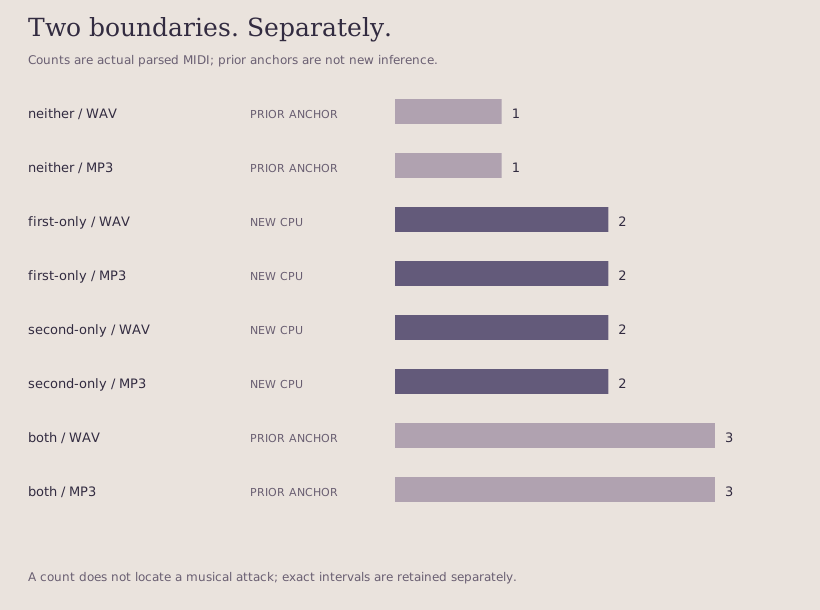
With the same authored 440 Hz source clock and global envelope, the actual WAV / MP3 MIDI counts were: neither reset 1 / 1, first boundary only 2 / 2, second only 2 / 2, both 3 / 3. The single-boundary cells are new offline CPU inference; the endpoints retain exact-input captures. These conditional counts do not identify intended musical attacks.
The middle cells
were not measured before.
| Cell | First reset | Second reset | WAV / MP3 events | Provenance |
|---|---|---|---|---|
| A / Neither boundary resets | no | no | 1 / 1 | Retained Oct17 anchor |
| B / First boundary only | yes | no | 2 / 2 | New Oct18 offline CPU inference |
| C / Second boundary only | no | yes | 2 / 2 | New Oct18 offline CPU inference |
| D / Both boundaries reset | yes | yes | 3 / 3 | Retained Oct17 anchor |
A / Neither boundary resets
First reset: no. Second reset: no. WAV / MP3 events: 1 / 1. Retained Oct17 anchor.
B / First boundary only
First reset: yes. Second reset: no. WAV / MP3 events: 2 / 2. New Oct18 offline CPU inference.
C / Second boundary only
First reset: no. Second reset: yes. WAV / MP3 events: 2 / 2. New Oct18 offline CPU inference.
D / Both boundaries reset
First reset: yes. Second reset: yes. WAV / MP3 events: 3 / 3. Retained Oct17 anchor.
The preceding exact-cycle and off-cycle comparison changed both internal reset boundaries together. It established a source-byte identity in one construction and a different output in another, but could not assign a conditional result to either boundary alone. Here B and C supply those missing source interventions. A and D remain labelled endpoints from the preceding off-cycle case, not newly discovered results.
There are 4 fresh input inferences, 4 retained prior inputs and 0 same-input reuses within this run. The paired WAV and MP3 encodings are not independent statistical replicates. Each reported count comes from its corresponding saved MIDI, and full pitch, timing and velocity fields are retained even when totals happen to match.
First-only versus second-only / WAV: counts 2 and 2. Complete parsed note fields identical: no. Actual MIDI bytes identical: no. These are separate checks, not conclusions drawn from matching totals.
First-only versus second-only / MP3: counts 2 and 2. Complete parsed note fields identical: no. Actual MIDI bytes identical: no. These are separate checks, not conclusions drawn from matching totals.
Hold the other switch.
Read the conditional difference.
| Comparison | Formula | WAV | MP3 |
|---|---|---|---|
| First reset, second off | B - A | 1 | 1 |
| First reset, second on | D - C | 1 | 1 |
| Second reset, first off | C - A | 1 | 1 |
| Second reset, first on | D - B | 1 | 1 |
| Cross-difference | (D - C) - (B - A) | 0 | 0 |
First reset, second off
Formula: B - A. WAV / MP3: 1 / 1.
First reset, second on
Formula: D - C. WAV / MP3: 1 / 1.
Second reset, first off
Formula: C - A. WAV / MP3: 1 / 1.
Second reset, first on
Formula: D - B. WAV / MP3: 1 / 1.
Cross-difference
Formula: (D - C) - (B - A). WAV / MP3: 0 / 0.
Enabling the first reset with the second disabled gives B - A. With the second enabled, the corresponding contrast is D - C. Enabling the second reset with the first disabled gives C - A; with the first enabled it gives D - B. The result JSON names every input MIDI filename and its actual parsed count. No curve or expected number of splits is substituted for an export.
The cross-difference (D - C) - (B - A) is 0 for WAV and 0 for MP3. It is arithmetic on this fixed construction, not a statistical interaction test, a probability, an accuracy score or evidence of a universal phase rule. Equal conditional count changes would still not prove equal start times, velocities or musical meaning.
The switches are separate generator decisions, but their downstream phase states need not be independent. With only the first restart, the oscillator retains that phase origin through the final slot. With both restarts, its origin changes again at the second boundary. Turning on the first switch can therefore change the phase state arriving at the second boundary even when the second switch is held fixed. This matrix separates the decisions; it does not claim to inject two identical, independent acoustic impulses.
A source boundary
is not a note label.
The first internal boundary is sample 22051, or 22051 / 22050 = 1.000045351473923 seconds. The second is sample 39692, or 39692 / 22050 = 1.800090702947846 seconds. These are selected construction positions. They are not onset times measured from a musical performance.
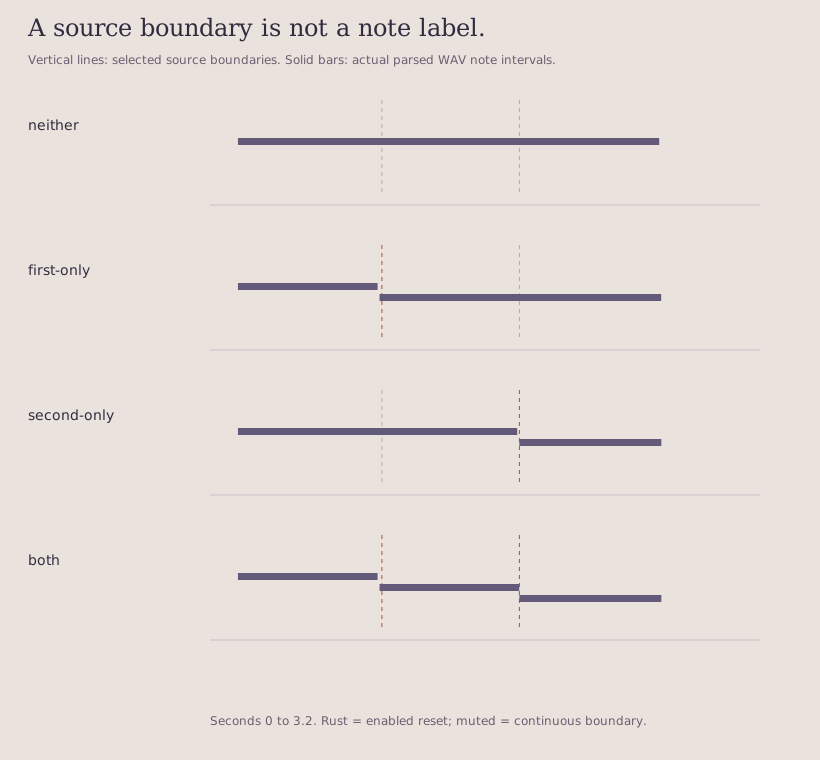
For each parsed event we retain two signed distances: startSeconds - firstBoundarySample / sampleRate and startSeconds - secondBoundarySample / sampleRate. The actual MIDI start field and exact source sample position supply the inputs. Negative means the exported event starts before that source boundary; positive means after. This is not a nearest-attack assignment, and we set no tolerance that turns a close distance into a correct note.
The display below rounds seconds to six decimal places. The result JSON preserves full numbers, ticks, duration ticks, PPQ and velocity; equality checks use full fields and byte hashes, not the rounded labels. An increase in the total does not by itself identify which interval was split, whether one vanished, or what a performer intended.
- Neither boundary resets / WAVevent 0: start 0.162500 s; distance from first -0.837545 s; from second -1.637591 s
- Neither boundary resets / MP3event 0: start 0.162500 s; distance from first -0.837545 s; from second -1.637591 s
- First boundary only / WAVevent 0: start 0.162500 s; distance from first -0.837545 s; from second -1.637591 s | event 1: start 0.986458 s; distance from first -0.013587 s; from second -0.813632 s
- First boundary only / MP3event 0: start 0.162500 s; distance from first -0.837545 s; from second -1.637591 s | event 1: start 0.986458 s; distance from first -0.013587 s; from second -0.813632 s
- Second boundary only / WAVevent 0: start 0.162500 s; distance from first -0.837545 s; from second -1.637591 s | event 1: start 1.800000 s; distance from first 0.799955 s; from second -0.000091 s
- Second boundary only / MP3event 0: start 0.162500 s; distance from first -0.837545 s; from second -1.637591 s | event 1: start 1.800000 s; distance from first 0.799955 s; from second -0.000091 s
- Both boundaries reset / WAVevent 0: start 0.162500 s; distance from first -0.837545 s; from second -1.637591 s | event 1: start 0.986458 s; distance from first -0.013587 s; from second -0.813632 s | event 2: start 1.800000 s; distance from first 0.799955 s; from second -0.000091 s
- Both boundaries reset / MP3event 0: start 0.162500 s; distance from first -0.837545 s; from second -1.637591 s | event 1: start 0.986458 s; distance from first -0.013587 s; from second -0.813632 s | event 2: start 1.800000 s; distance from first 0.799955 s; from second -0.000091 s
Keep the clock.
Change only the enabled resets.
The authored oscillator uses selected frequency 440 Hz at 22050 samples per second, with 70560 total samples. Active audio begins at sample 4410. Three touching slots each contain 17641 samples. One global envelope spans the full active interval, with 220-sample edges and nominal amplitude multiplier 0.35. No internal fade, positive silent gap or RMS normalization is introduced. Equal nominal amplitude is not a claim of equal RMS; each actual RMS is recorded.
The source evaluates sin(2π × (((i - origin) × 440) mod 22050) / 22050), multiplied by the global edge envelope and quantized to PCM16. The phase origin starts at the first active sample. At an enabled internal boundary it becomes that boundary's sample index; at a disabled boundary it stays at its most recent origin. The final active endpoint and the envelope remain fixed across all four cases. All construction slots are bookkeeping intervals, not asserted audible attacks.
For every conditional source pair, the independent checker verifies that PCM before the toggled boundary is unchanged and independently regenerates every sample and the WAV header. The measured changed-sample counts are neither to first-only: 35281; second-only to both: 17641; neither to second-only: 17640; first-only to both: 17639. Those values compare actual quantized source arrays. They are not human hearing thresholds, recommended edit settings or a count of correct notes.
The prior anchors are accepted only when regenerated input bytes, decoded mono float32 samples and model hashes match their Oct17 records. Their original capture timestamps remain intact. The new middle cells run the unchanged installed model on the offline CPU backend; the public converter and all older experiment bodies remain untouched.
Keep the capture
and its date together.
Basic Pitch 1.0.1, TensorFlow.js 3.21.0, MIDI writer 2.0.28, v24.19.0 on win32; CPU backend. Native FFmpeg encodes MP3 at 128 kbps and decodes each file to mono float32 at the selected sample rate. The onset and frame thresholds stay at 0.25 and 0.25; extraction minimum stays at 5 frames. All raw frame, onset and contour matrices are retained.
Model manifest SHA-256: 1ed1aaee3409ec1dc098c8b01f430c0911f6fe9412e7af8086750f9e8f302f68. Combined model weights: b142a95737a52e1e412d5f92e73d8bb80dfe8d04941acc0702f11f4524fb377c. Unchanged converter source: e42f9b0b60bb6fd73b2539a1ae9ca3b09f34ab874e35423162b384df68c19660. A separate replay re-extracts the capture, rebuilds each MIDI and requires its actual file hash and parsed fields to match the saved export. A retained row does not become a fresh experiment merely because this page is new.
MP3MIDITool's repair guidance distinguishes fragments belonging to a held note. That observed distinction motivates this evidence sequence, not a claim that its converter was tested here. The fixed comparison pages were read for workflow and gaps; no site-wide absence or current ranking claim follows from that read.
This is synthetic-source, offline CPU evidence. It is not a real-instrument recording, listening test, browser inference, physical-phone conversion, DAW result, musical-intent classifier or accuracy percentage. No source recording belonging to a visitor was used or uploaded. The previous joining experiment and repeated-note counterexample retain their separate rules and reciprocal links.
Read the event fields.
Not just the headline count.
Every line below is re-parsed from its actual Standard MIDI export. Display rounding is for reading only. The source reset choices, complete model capture and export remain separately downloadable, so a reader can inspect source geometry without treating a note total as the whole result.
- Neither boundary resets / WAVpitch 69; start 0.162500 s; duration 2.451042 s; velocity 0.614173
- Neither boundary resets / MP3pitch 69; start 0.162500 s; duration 2.451042 s; velocity 0.614173
- First boundary only / WAVpitch 69; start 0.162500 s; duration 0.812500 s; velocity 0.614173 | pitch 69; start 0.986458 s; duration 1.638542 s; velocity 0.614173
- First boundary only / MP3pitch 69; start 0.162500 s; duration 0.812500 s; velocity 0.622047 | pitch 69; start 0.986458 s; duration 1.638542 s; velocity 0.606299
- Second boundary only / WAVpitch 69; start 0.162500 s; duration 1.625000 s; velocity 0.614173 | pitch 69; start 1.800000 s; duration 0.826042 s; velocity 0.606299
- Second boundary only / MP3pitch 69; start 0.162500 s; duration 1.625000 s; velocity 0.614173 | pitch 69; start 1.800000 s; duration 0.826042 s; velocity 0.598425
- Both boundaries reset / WAVpitch 69; start 0.162500 s; duration 0.812500 s; velocity 0.614173 | pitch 69; start 0.986458 s; duration 0.812500 s; velocity 0.622047 | pitch 69; start 1.800000 s; duration 0.826042 s; velocity 0.598425
- Both boundaries reset / MP3pitch 69; start 0.162500 s; duration 0.812500 s; velocity 0.622047 | pitch 69; start 0.986458 s; duration 0.812500 s; velocity 0.614173 | pitch 69; start 1.800000 s; duration 0.826042 s; velocity 0.598425
Download the controls.
Recheck the inference.
Full results and provenance contain conditional formulas, source boundary positions, original timestamps, hashes and event fields. Reproduction code runs in this project's locked environment as node scripts/measure-boundary-isolation.cjs. Prior Oct17 evidence is required for anchor validation. The --replay option refuses missing captures instead of manufacturing inference.
- Neither boundary resets / WAV sourceRetained Oct17 anchor. Original capture time: 2026-10-16T19:09:26.370Z. Input SHA-256:
6f50b2385ba0fc0bbbc80eb0db68534b35b15e8a587a79d9c125b82791392984. Captured model output:f0d817257d4a696d51bcf8ac1ae09f8518ec79130f0572d15a5a909f980d914a. Actual MIDI:ea6ff796bc7200786da544dabad30b36d1b37b88a83312b5fd5edb079d18b836. - Neither boundary resets / MP3 sourceRetained Oct17 anchor. Original capture time: 2026-10-16T19:09:37.103Z. Input SHA-256:
715e11704a78427cb84c0bf8b19997ecf3ac2cc53d4e7b2e1c6a6c1b8ef6c33e. Captured model output:c96e3cb192d8d5bbdf1b1207dc34efe2325efcbe5ff6a1fd5f55164978ecd70f. Actual MIDI:ea6ff796bc7200786da544dabad30b36d1b37b88a83312b5fd5edb079d18b836. - First boundary only / WAV sourceNew Oct18 offline CPU inference. Original capture time: 2026-10-18T03:59:52.990Z. Input SHA-256:
5717d14a433763ad08676a3194a5f5cce6645149cf5cccb106e0d039f475f7c2. Captured model output:0c30695f73ce52870f30cd0754294ca5bf2fe1c1c733125fa3e86de55b8f52bf. Actual MIDI:9b06b137eac75cea4c89496acf1f66874d61bc446a2d993e239161af0179600d. - First boundary only / MP3 sourceNew Oct18 offline CPU inference. Original capture time: 2026-10-18T04:00:21.477Z. Input SHA-256:
40cecf2f9251c9d756266eb1437415d5cff0ad0d093216606005427d3bf95797. Captured model output:1e705817ff47cccd5781537affbd0fff377ede6613697670cbd2d88d3e8a06b9. Actual MIDI:48f41d2caf7a6702e4f52ade6241675ae32d9da262772bc385032f8e501bda74. - Second boundary only / WAV sourceNew Oct18 offline CPU inference. Original capture time: 2026-10-18T04:00:55.335Z. Input SHA-256:
85d935ba4b881059cf2fb3254f2c7fc08818ebd65126d9aca12933411be51ece. Captured model output:c1334d608de171abadfd9499a6c71e0ca7fbea595324c199b85f1b408495f0fd. Actual MIDI:d579396eb3a4f000c3cd18587271d5a0dbba44e1f6699f2d62e9697adc1270ad. - Second boundary only / MP3 sourceNew Oct18 offline CPU inference. Original capture time: 2026-10-18T04:01:27.689Z. Input SHA-256:
1ee66119d8a0c8953077398bc26085007898f7eac1ebb70a58ef56a429eaf197. Captured model output:7cf5463398ccaeb77f1b25efde734678a75d70546d7306fc165083e81640148e. Actual MIDI:3cca788b6844af29fc4fe9e1df3db083a02f9904842dc5a0515d8c97e7548423. - Both boundaries reset / WAV sourceRetained Oct17 anchor. Original capture time: 2026-10-16T19:09:48.603Z. Input SHA-256:
1da80be5b2ec61a65415a39c34392bc058784d76d09e1ec55938ccccd8545286. Captured model output:3188fdc07f402b55f78636b33570c304b510e576c591ffb137a9d530a7d0798d. Actual MIDI:c3f549d17c4bdce2f3920f2158a6f7ab38ba41554844b378c42ba05690f94a0c. - Both boundaries reset / MP3 sourceRetained Oct17 anchor. Original capture time: 2026-10-16T19:09:58.775Z. Input SHA-256:
702c1176dc3ea7bc6f3ce298052e456576c937e249fc0671b08ff43807eef4ec. Captured model output:fae79409aecec895d2d3814f58c1cd23080dc8eac3c8b397e5b1769cdd6b8e3b. Actual MIDI:e825e879d3434cfd8ddc7720973b9d45ec47d048c896c77be79ce7146566eadf.
The page reports actual measurements rather than predicted results. Its conditional changes are limited to the declared source, sample clock, phase arithmetic, envelope and model path. They do not supply a safe musical rule for other audio. The preceding phase-boundary page remains available with its original exact-cycle and off-cycle claims.